
In short
- Every outdoor pool loses water to sun and wind. On an open Ballito stand the loss is larger, and it rises and falls with the weather.
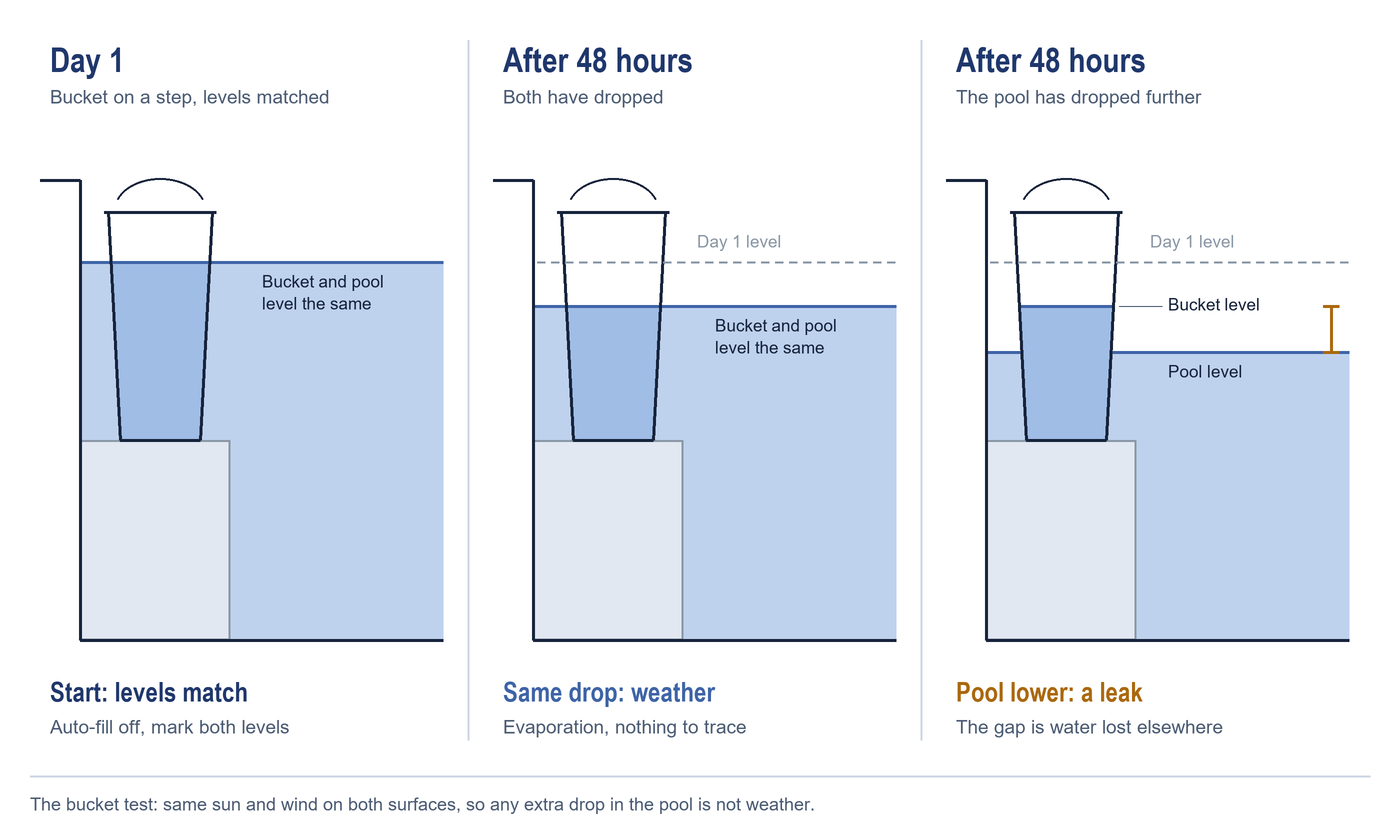
- The bucket test settles it for free: pool water in a bucket on a step, levels matched, auto-fill off, 48 hours. Equal drops mean weather. A pool that drops further than the bucket is leaking.
- Losing more with the pump running, wet ground near the pool or pump, a level that stops at the skimmer or light, or a trickle from the backwash outlet all point to a leak.
- A holiday house on auto-fill can leak for months unnoticed. At Siza Water's 2026/27 rates, each extra kilolitre in the 10 to 30 kl band costs R54.55 with the sewer charge.
A pool losing water in Ballito is hard to judge by eye. Many pools on this stretch of coast sit on slopes facing the sea with nothing between the water and the wind, and some of what disappears is simply weather. The rest may be a leak. Telling the two apart before anyone lifts paving or books a test costs nothing, takes two days, and tells a Ballito plumber where to start if one is needed.
What Normal Pool Water Loss Looks Like In Ballito
Evaporation depends on water temperature, sun, humidity and wind, and wind is the one that varies most between two houses in the same road. Moving air strips the damp layer off the water and replaces it with drier air, so an open stand above the beach can lose noticeably more than a pool behind a wall a few streets back.
Ballito's climate pulls both ways. Weather Spark's long-term data for the town put the windier part of the year between mid-August and early February, with October the windiest month at an average of about 22 km/h. In January the prevailing wind is from the east, off the sea, daytime highs are around 27°C and the sea surface is close to 25°C. Summer is also humid: most January days count as muggy, and humid air takes up water more slowly. A still, sticky December afternoon can take less from a pool than a bright, breezy day in October.
Weather loss therefore has a recognisable pattern:
- It follows the weather. The level falls faster through windy, sunny spells and slows when it is calm or overcast. A loss that stays high on a still, grey day is not evaporation.
- It has no floor. Evaporation works on the surface wherever the surface is, so it never stops at a particular height.
There is no single normal figure for a Ballito pool, and one written for another climate does not transfer. The arithmetic does: every millimetre the level drops is one litre for every square metre of surface. An 8 m by 4 m pool has 32 m² of surface, so 5 mm off the level is 160 litres.
Why A Pool Loses Water Without A Leak
Weather is not the only ordinary way water leaves a pool. Account for these before suspecting that anything is broken:
- Splash-out. Water thrown onto the paving and carried out on swimmers is real loss, and it peaks when the house is full in December.
- Backwashing. Every backwash and rinse sends pool water down the waste line. A filter backwashed often, or for longer than it needs, takes the level down each time.
- Rain that hides the trend. Ballito's wetter season runs from about the end of September to early April. A heavy shower tops the pool up and can cancel out days of loss, so read the level between rain rather than across it.
- The automatic top-up. A float valve or auto-fill that holds the level steady also hides how much it is putting back, so the first sign of trouble is often the water account. It has to be off for any test to mean something.
The valve that looks like a leak
When the internal seal of the filter's multiport valve wears, water passes to waste the whole time the pump runs, even with the handle on "filter", and the pool drops as if the shell were leaking. With the pump on and the valve set to filter, look at the backwash outlet. A steady trickle there is pool water leaving, and it is a valve problem rather than a hole.
The Bucket Test: Is Your Pool Losing Water To A Leak?
The bucket test compares the pool with a sample of its own water under the same weather. Whatever sun and wind take from the bucket, they take from the pool too, so any extra loss has another cause.
- Switch off the auto-fill and don't backwash until the test is over.
- Fill a bucket with pool water and stand it on the first or second step so most of it is under water. A brick inside keeps it from tipping.
- Match the levels by adding or scooping out water until the level inside the bucket lines up with the pool outside it.
- Mark both lines with a waterproof marker or tape: the water inside the bucket, and the pool level on the outside of it.
- Leave it for 48 hours with the pump on its usual timer, then compare how far each level has dropped.
If both have dropped by the same amount, the loss is weather and there is nothing to trace. If the pool has dropped clearly further than the bucket, something other than the weather is taking water, and the gap between the two marks is the size of the leak over two days.
Rain spoils the comparison, so start again if a shower comes through. If the pool is losing more, repeat the test for a day or two with the pump off. More loss with the pump running points to pipework that is only under pressure while it runs; the same loss either way points to the shell or a fitting.
Signs Your Pool Is Losing Water Through A Leak
These signs point towards a leak rather than weather. Any one of them is reason enough to run the bucket test:
- It loses more with the pump running. Evaporation does not care whether the pump is on, so a clear difference is a plumbing clue.
- Wet ground that should be dry. A soft patch of lawn between the pool and the pump, damp soil around the equipment, paving that has sunk or lifted, or a damp wall in a pump room below the pool.
- The level stops at a fitting. With the top-up off, a leak drains the pool down to its own height and no further, so a level that settles at the skimmer mouth or just below the light points at that fitting. Switch the pump off if the water falls below the skimmer mouth, because a pump drawing air can run dry and be damaged.
- Cracks and loose fittings. Cracks in the shell or coping, tiles lifting at the waterline, or gaps around the skimmer, light or returns.
- The meter turns with nothing running. With the auto-fill connected and every tap shut, a moving meter means water is going somewhere. The meter check for the house itself is on our leak detection page.
Holiday Homes: A Pool Losing Water With Nobody There
Ballito's year is lopsided. According to a 2024 Moneyweb report, the Siza Water concession serves 70,000 to 80,000 customers a day, rising to more than 200,000 in the holiday season. Many houses behind that swing stand closed for most of the year, the pump on a timer and an auto-fill keeping the level up.
That is the worst arrangement for a pool leak. The top-up replaces whatever is lost, so the waterline looks normal, and nobody is there to notice a soft patch of lawn. The first sign is often a water account months later. A few habits catch it early:
- Ask whoever looks after the pool to run the bucket test in October or early November, well before the house fills up.
- Have someone read the water meter on the same date each month and send you the figure. A closed house with a sound pool should use very little.
- If a reading jumps, have the auto-fill switched off for two days and the level marked, with someone checking that the water stays above the skimmer mouth.
What Pool Water Loss Costs On A Siza Water Account
Ballito, Zimbali, Salt Rock and Umhlali all fall inside the Siza Water concession, which has supplied this part of the coast since 1999 under a 30-year agreement with the iLembe District Municipality. Its 2026/27 tariffs took effect on 1 July 2026, with water up 6.47%. On a standard residential account the first 10 kl a month carry no consumption charge on top of the R266.20 monthly basic charge. Above that, each kilolitre is charged on a rising scale, and a house on the sewer also pays R22.45 per kilolitre of water used. All figures include VAT:
| Household use in the month | Water, per kl | Water plus sewer, per kl |
|---|---|---|
| First 10 kl | R0 (basic charge applies) | R22.45 |
| Over 10 kl, up to 30 kl | R32.10 | R54.55 |
| Over 30 kl, up to 40 kl | R42.00 | R64.45 |
| Over 40 kl, up to 50 kl | R67.20 | R89.65 |
| Over 50 kl | R84.20 | R106.65 |
Go back to the 32 m² pool and suppose a leak takes an extra 10 mm a day on top of the weather. That is 320 litres a day, or about 9.6 kl over a 30-day month. For a household already using 15 kl, all of it lands in the 10 to 30 kl band and adds roughly R524 to the month. A bigger leak or a busier house pushes the account into the dearer bands.
These are Siza's rates. Stanger sits outside the concession, so accounts there are billed differently.
No water restrictions in force
Siza's tariff sheet also lists higher restriction tariffs, but they apply only while restrictions are in force. For May 2026 to April 2027 the Department of Water and Sanitation set no restrictions on the North Coast system, whose source, Hazelmere Dam, was above full supply capacity at the start of the year. Hazelmere's raised wall, commissioned in October 2024, was built partly to augment supply to Ballito.
Finding A Leak In A Pool: What A Detection Visit Involves
Once the bucket test has shown a real loss, guessing at it is where the money goes. A pool leak detection visit works from the cheapest, most likely causes towards the most expensive:
- Your results first. The bucket test figures, the pump-on and pump-off difference and where the level settles narrow the search before any equipment comes out.
- The equipment. Pump, filter, multiport valve, backwash line and the visible pipe joints around them.
- The shell and fittings. Skimmer throats, light niches, returns and steps, often with a little dye released near a suspect spot while the water is still.
- The buried lines. Each pipe is sealed at the pool end and pressure tested, so the line that will not hold pressure is found without lifting paving on a hunch.
- A plain report. What is leaking, where, and what the repair involves. The repair is quoted separately once the cause is known.
The pool stays full throughout, because an empty shell loses the weight of water that holds it down against the ground. When you get in touch, send the bucket test result, whether the loss changes with the pump, and whether the house is occupied.
Pool Losing Water: Questions Ballito Owners Ask
Is it normal to have to add water to a pool every week?
On an exposed Ballito stand it often is, especially in the windier months from August to February and when the house is full. What matters is whether the amount matches the weather. If you top up as much after a calm week as after a windy one, run the bucket test.
How much water should a pool lose per week?
There is no fixed figure. Wind, sun, humidity, water temperature and shelter all change it, so two pools in the same Ballito road can lose different amounts with nothing wrong with either. Compare your pool with a bucket of its own water over 48 hours instead of with a number.
Why is my pool losing water but there is no leak?
Evaporation, splash-out, backwashing and rain overflow all take water without anything being broken. Check the backwash outlet too: a multiport valve with a worn seal passes water to waste whenever the pump runs, which looks exactly like a leaking pool.
Is it normal for a pool to lose water overnight?
A little, yes. Evaporation carries on after dark, only more slowly. A large overnight drop, particularly with the pump off, is more than the weather explains and is worth a bucket test.
How can I tell where my pool is leaking?
The pattern gives the first clues: more loss with the pump running points at the pressurised pipework, a level that settles at the skimmer or light points at that fitting, and wet ground shows where water is surfacing. Pinning down the exact spot takes pressure testing, which is what a pool leak detection visit does.
Sources
- Siza Water: 2026/2027 tariff document (tariffs effective 1 July 2026)
- Siza Water: Company overview (concession and areas supplied) (accessed 12 October 2026)
- North Coast Courier: Siza Water implements sustainable tariff increases (6 August 2026)
- Moneyweb: Privately-run water companies come to the rescue (Ciaran Ryan, 12 August 2024)
- Engineering News: DWS outlines 2026/27 operating measures for uMngeni, North and South Coast water supply systems (21 August 2026)
- South African Government: Minister Pemmy Majodina commissions world's highest Piano Key Weir dam (Hazelmere Dam) (28 October 2024)
- Weather Spark: Climate and average weather year round in Ballito (MERRA-2 reanalysis, 1980 to 2016)
- Weather Spark: Average weather in October in Ballito
- Weather Spark: Average weather in January in Ballito
Written by The Ballito Plumbers, plumbers working across Ballito, Salt Rock, Umhlali, Zimbali and Stanger. To book, call 087 721 5110 or use the form below. This is general guidance; a plumber on site can tell you what applies to your property.